
No One Arranged This
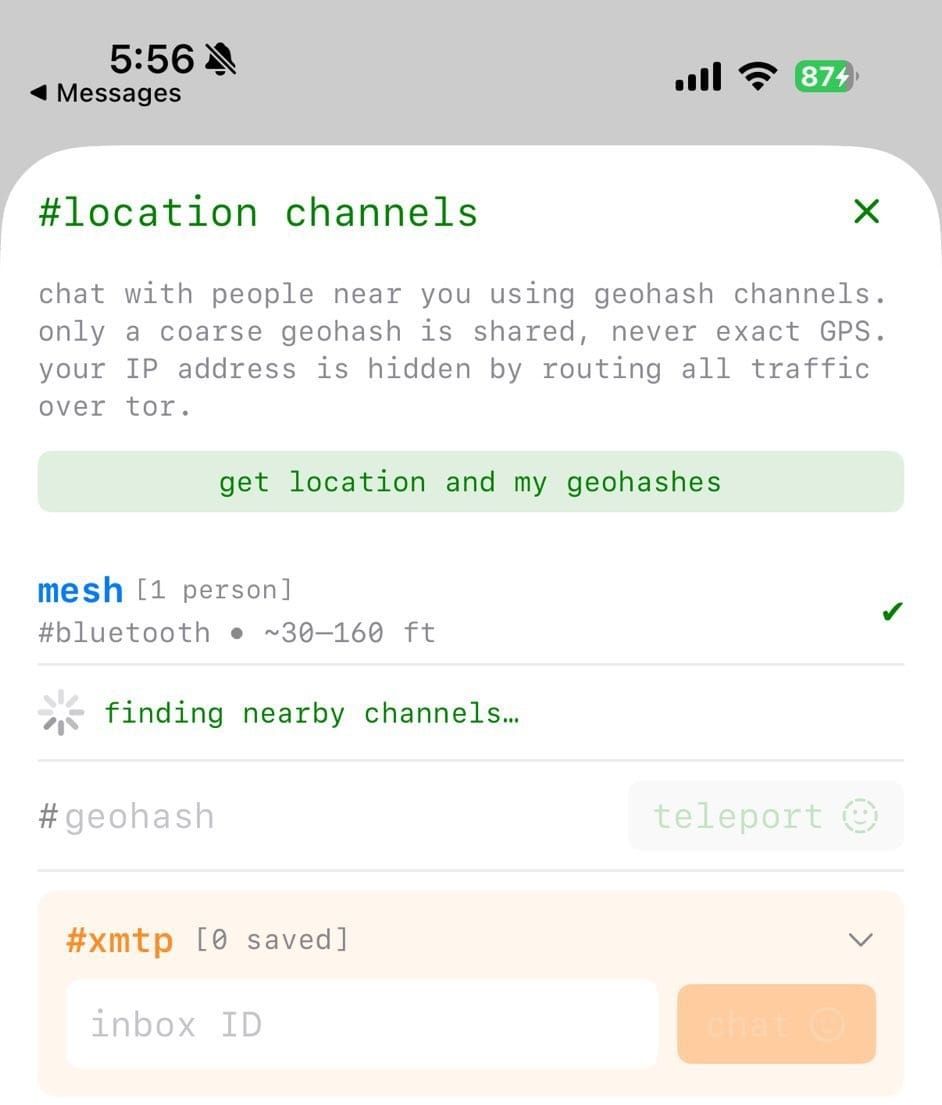
I got a notification yesterday that I've never gotten before.
"Someone nearby is on Bitchat, the mesh network."
I looked up. My coworker was sitting three feet away. She said, "I think it's me!"
I opened BitChat. It was her, I had never had that experience happen before, quite magical if I must say so myself.
Bitchat is a messaging app, started by Jack Dorsey, that works over Bluetooth. No internet. No cell towers. Just phones talking to phones within thirty to a hundred and sixty feet.
And there on the screen, in orange, was XMTP, the protocol we've spent years building.
And someone, without asking us, without a partnership, without a phone call, without a single contract, just put it inside their app.
No one arranged this.
Think about what these two things do together, especially with everything that is going on in the world right now.
Bluetooth for when you're close. Decentralized messaging for when you're not.
A government shuts down the internet. Cell towers go dark. Every app that needs the internet stops working. BitChat's Bluetooth mesh still works. Phone to phone. No server to seize.
But Bluetooth only reaches so far. What happens when you need to talk to someone later who's now in a different city? A different country?
That's XMTP. A decentralized messaging network with quantum-resistant encryption. Designed so that no country has more than 50% of the nodes, so that if any country changes its views on privacy and encryption, the network will continue to operate.
The keys you exchanged over Bluetooth, face-to-face, are the same keys that reconnect you later over XMTP. Even if the app gets banned. You can use another version of the app or website to access all of your messages.
The app is just a window. Shut one, open another. You still own the key that owns your messages.
With AI, someone can rebuild the app in a day. Ban one, ten more appear. Your messages come with you. Because your communication belongs to you. Not to a company. Not to a country.
Everything changes when a key owns the messages, not the app.
This is how the internet used to work. HTML didn't ask permission from HTTP. Email didn't need a partnership with the browser. Open protocols just found each other. Then the platforms walled everything off. Two companies control whether or not the entire world's communication gets shut off.
What I can't stop thinking about isn't what BitChat and XMTP do. It's how it happened. Someone just built on open infrastructure, combined two things that were never designed to go together, and something bigger emerged.
No partnership announcement. No press release.
Two open protocols found each other in the wild. Just like two phones did, sitting three feet apart.