
The Wrong Question, Answered Perfectly
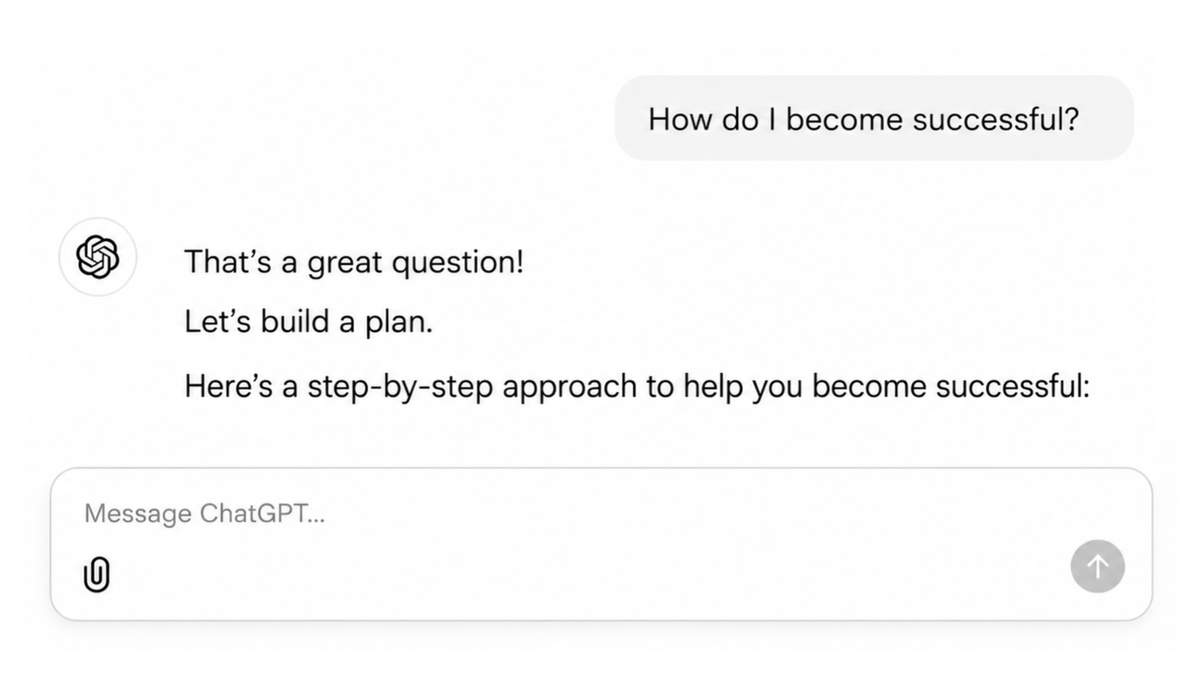
This morning I came across a search from about a year ago. I remember sitting at a coffee shop in Nashville and I typed a question into Claude:
"How do I get one of our leaders to take more ownership?"
Eleven seconds later I had a plan. Frameworks. Scripts for the conversation. A checklist. It was genuinely good. I felt that little wave of relief you feel when a problem becomes a document.
A few days later I realized the real question was different:
"Have I actually given this person the authority and context to own everything?"
I hadn't. The problem was me. The AI never had a chance to tell me that, because I never asked. It answered the question I gave it, beautifully, and the beauty of the answer made my bad framing feel more true.
I've watched every interface era train a behavior into us. Google trained us to search. Feeds trained us to scroll. AI is training us to ask once and accept.
And I think we can all feel what that's doing to us, even if we haven't named it yet.
You know the feeling. You're anxious about something at midnight. A relationship, a decision, a job, your kid, your company. You type it in. And what comes back is calm, structured, confident, and instant. It feels like progress. You close the laptop feeling better.
But notice what actually happened. You didn't think. You got answered.
For all of human history, answers were the scarce thing. Knowledge lived in experts and libraries and elders and the one person in town who'd been through it. Getting an answer took work, and the work was where a lot of the thinking happened. You'd explain your problem to a friend and halfway through explaining it, hear yourself, and realize the problem wasn't what you thought.
That friction is gone now. The cost of producing an answer is approaching zero.
But the cost of pursuing the wrong question is not zero.
A wrong answer wastes your time.
A wrong question can waste your life.
Here's the part nobody in the industry wants to say out loud: AI answers the question it's given. That's the whole trick. It continues your frame. If your frame is sound, that's a superpower. If your frame is incomplete, defensive, inherited, or just wrong, you now have a machine that will help you be wrong faster, with better formatting. And it will keep driving that direction until you realize it's the wrong way.
Ask it "how do I stop fighting with my partner" and you'll get communication tactics. The real question might be "what am I not saying because I'm afraid of what honesty could change?"
Ask it "which startup idea should I pursue" and you'll get market analysis. The real question might be "am I looking for a real problem, or an identity that makes me feel important?"
Ask it "how do I become more productive" and you'll get a flawless operating system for your life. The real question might be "why am I filling every hour with work I no longer believe matters?"
The answer can be technically excellent and personally useless. Worse than useless, actually. Because a coherent, detailed, confident response makes the original framing feel legitimate. The polish launders the premise.
And these things will argue any side you hand them. Ask why your cofounder is being unreasonable and it'll build the case. Ask why you're the unreasonable one and it'll build that case too. Ask why the market is about to explode, or collapse, and it'll do both, equally well, equally sure of itself. We didn't build an answer machine. We built a confirmation machine with great manners.
Nobody's lying to you. That's what makes it hard to see. Every individual answer can be factually fine. The failure lives one level up, in the question, and maybe the question we couldn't see.
There's a name for what this does to us: premature closure. The first plausible answer arrives so fast that the search feels finished before it started. You feel something, you type something, you get an explanation. The gap between impulse and interpretation, the uncomfortable gap where you used to sit with a thing and let it turn over, is gone. We're not more certain than we used to be. We're just certain sooner.
I know people who spent a decade answering "how do I prove I'm successful?" They built the company. Made the money. Got the recognition. And then found out the question itself came from fear, and no answer was ever going to close it. A wrong question doesn't just produce a bad response. It produces your goals, your metrics, your enemies, your evidence, your identity. And now we've got machines that can accelerate that pursuit to a speed no generation has ever had access to.
The whole industry is racing in one direction: better answers. Faster, cheaper, more personalized, more capable. Fine. But what if the answer was never the bottleneck?
Everything I've ever seen change, in companies, in families, in my own life, started with a question somebody finally became willing to ask. Or actually able to see. Not the first question. The one underneath it. The one beneath the argument, beneath the ambition, beneath the behavior, beneath the answer you were hoping to hear.
The first question is almost never the question. I've spent almost 20 years of my life thinking about questions, and it's still crazy to me how much is beneath each question that we can't see. I even built a little tool to keep track of impactful questions and a way to help me see underneath whatever question is on my mind.
So here's what I've started doing, and it's embarrassingly simple. Before I hit enter, I ask myself one thing: what am I hoping this answer will let me avoid?
Sometimes the honest answer is "a hard conversation." Sometimes it's "admitting I already know." Sometimes it's "sitting still for five more minutes with something uncomfortable." Sometimes the question I typed is fine and I should hit enter. But that one beat of noticing changes everything, because it puts a human back in the loop. Me.
I'm not anti-AI. I build with this stuff every day and I think the people calling for us to unplug are as lost as the people calling it a god. The tools are extraordinary. But the more infinite the answers get, the more the questions are all that matters. It's the last part of the process the machine can't do for you, because the machine doesn't know what you're avoiding, what you're protecting, or what you're not ready to hear. Only you know that. And only if you slow down long enough to look.
The most important skill left isn't prompting. It's pausing to notice the question underneath the one you typed.