
We're Still Riding the Horse
May 2026, 4 p.m. Sitting at my mom’s house in Southern California. Homemade Italian beef, great conversations on the couch and a shower head that doesn’t go above my chest. I’ve been here two days after a stretch of work that left me exhausted in the way that only feels obvious once you stop.
A great time to finish the book I’ve been reading.
David Whyte wrote Crossing the Unknown Sea in 2001. Twenty-five years ago. Before the iPhone. Before Slack. Before anyone had heard the phrase "artificial intelligence" outside a research lab.
He wrote it about work. About what happens to people when the organization asks for their creativity but won't make room for their fear. About the language we use in companies and how that language has become too small for what we're trying to do. About the conversation that every organization is afraid to have.
I just finished it. And I can't stop thinking about one part.
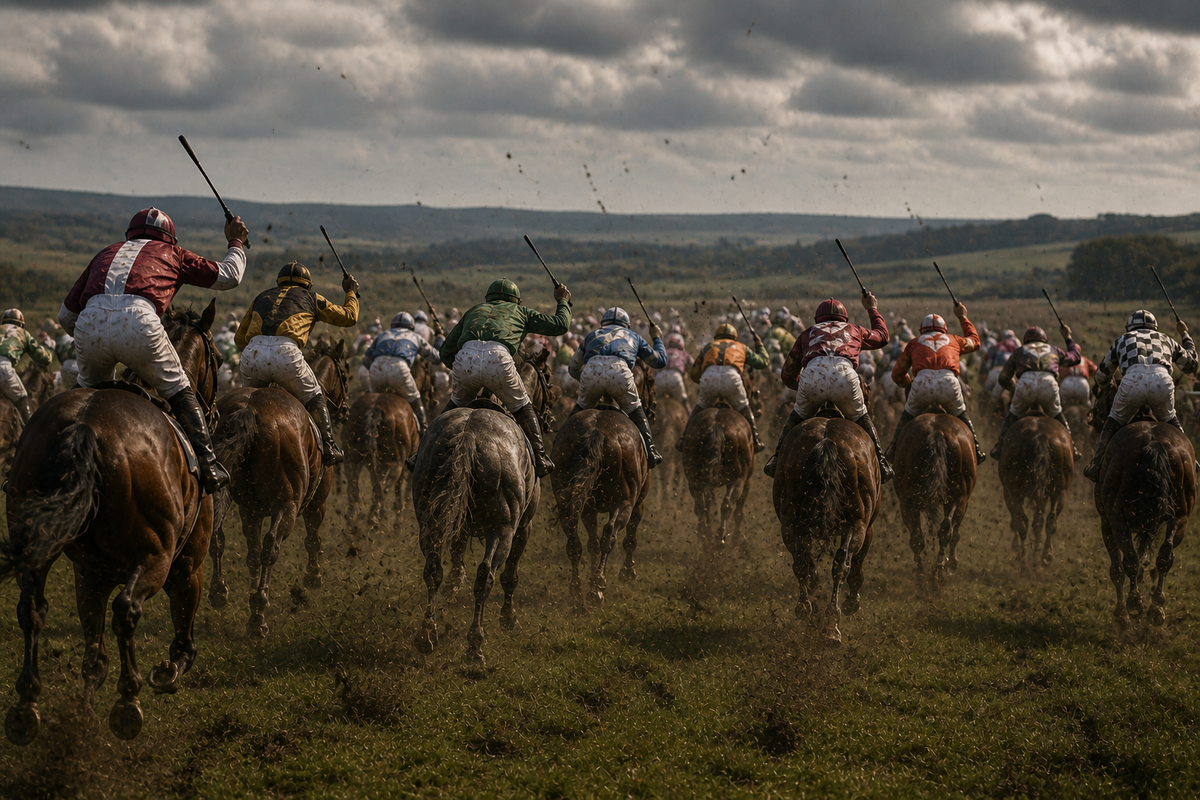
Whyte traces the word manager back to its roots. It comes from the old Italian maneggio and the French manège. The literal meaning: the training, handling, and riding of a horse.
He writes: "The word manager conjures images of domination, command, and ultimate control, and the taming of a potentially wild energy. It also implies a basic unwillingness on the part of the people to be managed, a force to be corralled and reined in."
Then he adds a line I can't get out of my head: "Most people don't respond very passionately or very creatively to being ridden, and the words giddy up there only go so far in creating the kind of responsive participation we now look for."
I laughed out loud. And then I stopped laughing. Because we're still doing it. Twenty-five years later, in the age of AI and autonomous agents and self-organizing systems, our two most common leadership titles still come from the thought of horse training.
Manager. Director. We literally hire people to tame the horse. But we are asking them to be creative and figure out ways to let the horse run wild.
We're still riding the horse.
The conversation nobody's having
Here's what I keep thinking about, sitting at my mom's kitchen table with nothing urgent for the first time in weeks.
Every company I know is talking about AI. How to use it. How to deploy it. How to integrate it. How to ship faster with fewer people. How to obey it. How to harness it. The conversation is almost entirely mechanical. What tools. What models. What workflows.
Nobody is talking about what Whyte was talking about twenty-five years ago. The human side. The part that doesn't scale. The conversation that has to happen between people before any tool means anything.
Whyte wrote: "Conversation is the heart of human life, and conversation is also the heart of commerce." Then he said every organization has to keep three conversations alive at the same time. A conversation with the unknown future. A conversation with customers. And a conversation between the people who actually work together every day.
But here's the part that hit me: "The depth and usefulness of all these outer conversations depend upon an internal conversation that is occurring within each individual."
In other words, you can't have a real conversation with your team if nobody on the team is having a real conversation with themselves.
I don't think we're having that conversation. Not in tech. Not anywhere I can see.
The human conversation is where we find meaning in our work and our lives.
What we're afraid of
Whyte says something about fear that I've never heard anyone in business say.
He says there is no creativity without a sense of high stakes or a sense of potential loss. If the risk is real, some of those losses will become actual. That fear, loss, difficulty, and failure are the qualities that make the conversation about creativity in the workplace real.
Read that again. He's not saying overcome your fear. He's not saying fail fast. He's saying the fear is the point. The organization has to make room for it, not manage it away.
"To acknowledge the hidden part of human beings is to make a home for them."
I think about our team. Every one of them is working on something that might not matter in five years. Or might be the most important thing they've ever built. Both of those are true at the same time. And the only way to hold that is to be honest about it. Not with a town hall slide. With an actual conversation.
Whyte says that when you try to engage people without that honesty, you cultivate a conversation with no heart and no affection. I've been in those conversations. I’ve been the reason they happened. The ones where everyone says the right words and nobody means them. Where the strategy deck is beautiful and the room is dead.
The question I can't answer
So what replaces manager? What replaces director? In this new world, does this type of role even exist? People like Jack Dorsey are saying it’s about players and coach/players. The middle layer is gone.
Whyte predicted the word would disappear within fifty years. We're halfway there. The word hasn't disappeared, but the thing it describes is dissolving underneath it.
A manager used to be the person who held the information. Who assigned the tasks. Who approved the decisions. Who stood between the team and the work.
AI does most of that now. Or it will soon. The routing, the tracking, the summarizing, the scheduling, the status updates. The horse-riding part of leadership is getting automated.
So what's left?
I think what's left is the thing nobody wants to talk about. The conversation. The real one. The one where you ask people what they're afraid of and you tell them what you're afraid of. The one where you admit you don't know if this is going to work. The one where the uncertainty isn't a problem to solve but the condition you're working inside of.
Whyte calls it "the meeting place of creative anticipation and fearful arrival."
I don't have a word for it. I don't think anyone does yet. But I know what it feels like. It feels like sitting in a room with people who are building something they believe in and being honest that the outcome is not guaranteed. That the work might fail. That the fear is real and the stakes are real and the only way through is together.
That's not management. That's not direction. It's something else. Something we don't have language for yet. But something more important than ever in a moment when everything about work is changing.
The inherited language
Whyte writes: "The inherited language of the corporate workplace is far too small for us now. It has too little poetry, too little humanity, and too little good business sense for the world that lies before us."
He wrote that in 2001. Before AI. Before remote work. Before any of this.
And somehow it's more true now than when he said it. The language of the modern workplace is almost entirely mechanical. Align. Optimize. Scale. Ship. Execute. Leverage. These are engineering words applied to human beings. They work for machines. They don't work for people.
Whyte says that for a real conversation, we need a real language. And to his mind, that language isn't in business books. It's in Keats. Wordsworth. Emily Dickinson. Mary Oliver. Poets who say more in one line about the invisible structures of a workday than a shelf of business books.
I think about that and I think he's right. The most important conversations I've had as a CEO were never in the language of business. They were in the language of honesty. I'm scared. I don't know. I think we need to change. I think I was wrong. These aren't strategic phrases. They're human ones. And they're the ones that actually moved things.
That actually changed what needed to change. Maybe these conversations are the only things that will matter in our work in the future. If the machine can do most of the work, we humans had better figure out how to have the hard conversations. Without them, we will just be chasing the machine. Without stopping to ask, where are we even going?
What I think is coming
A good artist, Whyte says, is fifty to a hundred years ahead of their time. They describe what lies over the horizon before all the evidence is in.
He wrote this book twenty-five years ago. He might be exactly twenty-five years ahead.
Because everything he described is happening right now. The mechanical parts of leadership are being absorbed by machines. The human parts are becoming more important, not less. And the organizations that figure this out, the ones that learn to have the real conversation, the one that includes fear and uncertainty and affection, those are the ones that will matter.
Technology's gifts only make sense, Whyte writes, "when cradled by a network of human conversation, a robust conversation that forms a parallel human network just as powerful as our computer networks."
That's the work. Not the AI. Not the tools. Not the models. The human conversation that holds all of it.
I don't know what the new word for manager is. Or if that type of work even exists anymore. I don't know what or who replaces director. I suspect it's something closer to host. Or steward. Or maybe it's a word that doesn't exist yet, one that holds both the ambition and the fear, the strategy and the soul.
I know what it isn't. But I don't think it's someone riding the horse.
We've been riding the horse for centuries. The horse doesn't want to be ridden anymore. And maybe the rider is tired too.
I'm going to sit here a while longer. The Italian beef is heating up in the crockpot, my favorite food from childhood. My mom is making coffee at 4 pm, like mother like son. The book is still open on the table. I literally finished reading it and instantly wrote this post. I don't have answers. I just have even more questions. And I think that might be enough for now.